

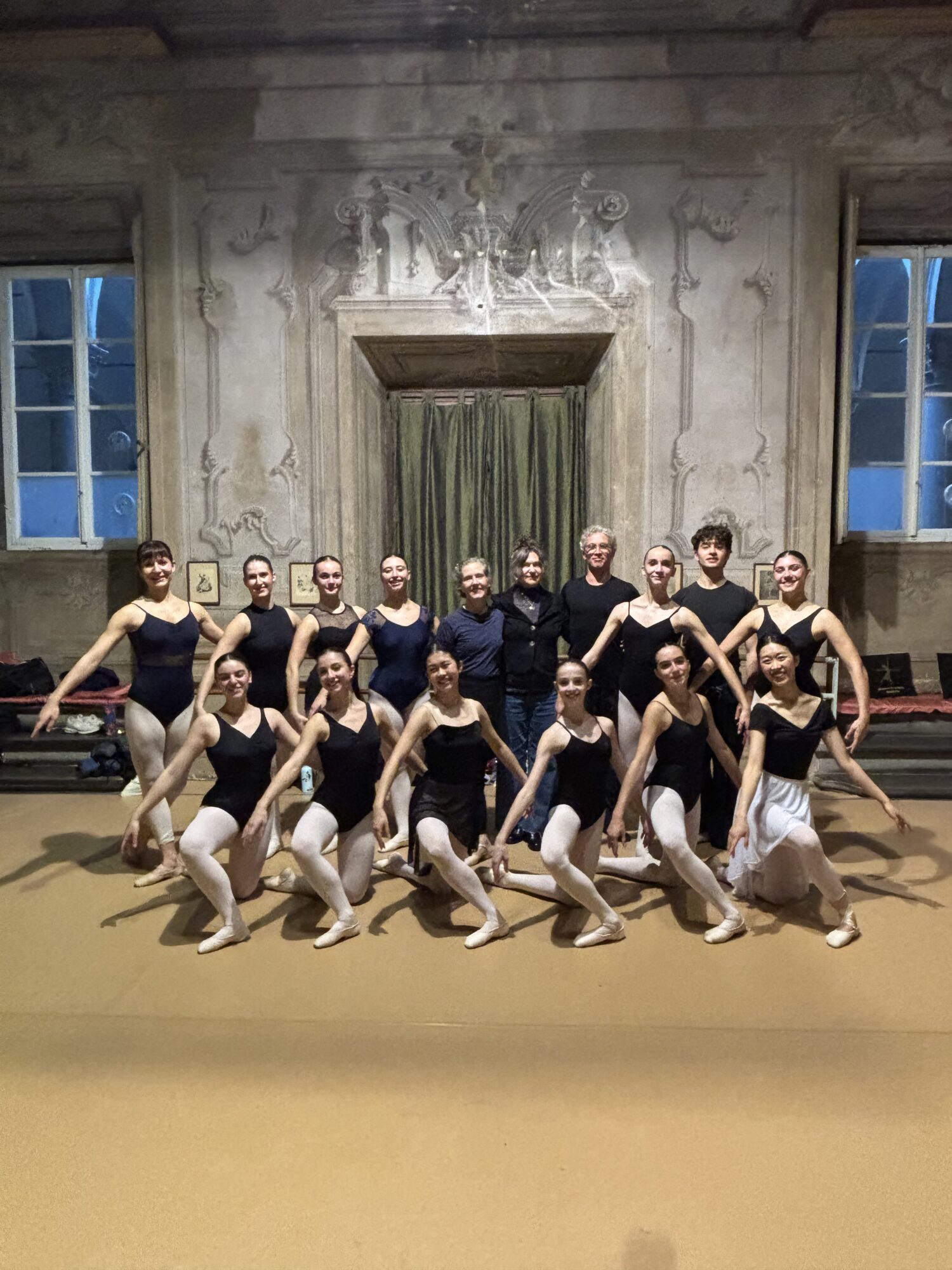
The author wishes to express grateful thanks to the Directors of Hamlyn: Nicoletta Santoro, Alessandra Alberti and Elisa Corsini, accompanying pianist Maria Korableva, and to Pier Paolo Gobbo, Director of Almadanza.
‘It is the mission of art in general, and the theatre in particular, to intensify thought, elevate the mind and vivify the senses.’
Bournonville’s Choreographic Credo
Movement in the Mind
Both Bournonville and Cecchetti were clear about what the art form must represent in the theatre: a stand-alone, telling a coherent story and transmitting ideas – the joy of existence! Bournonville and Cecchetti used the step vocabulary, because all they needed could be said through it. Onstage, Bournonville’s choreography does this exactly.
Form is Function
Classical ballet is subject to the Laws of Nature. The splendid plastique (what Karsavina called Flow of Movement) and theatricality inherent in both Bournonville and Cecchetti’s classes, is possible only because both respected our frame’s limitations and true beauty emerges only from a proper and intelligent use of the human frame.
Meeting Peter Brandenhoff, Bournonvilien, at Lille
In late May 2025, the author met with Peter Brandenhoff and Katharine Kanter at Lille. Mr Brandenhoff is a former professional dancer now teacher, trained at the Royal Theatre at Copenhagen and whose grandparents were dancers there. He is now researching Bournonville’s Etudes Chorégraphiques a three-volume treatise on classical dance technique written between 1848 and 1861, and assisting Danish ballet historian Alexander Meinertz with the latter’s upcoming biography of August Bournonville. Katharine Kanter is President of the Société Auguste Vestris, a non-profit, teaching society created in 2007 to promote the work of great ballet masters and teachers. She contacted Mr. Brandenhoff and an idea was born for a Cecchetti-Bournonville exchange on principles. This materialised in May 2025 at Lille. There, our in-studio “model” was Annabel Pearce-Ricard a former professional dancer now teaching in Lille; Roxana Barbacaru, teacher at the Paris Opera School and at the Conservatoire national supérieur de musique et de danse de Paris (CNSMDP), attended as observer.
Eternal things, enduring classics
Although Bournonville’s ballets are still performed worldwide despite their “great age”, oddly, this does not apply to Cecchetti’s Method, often dismissed as outdated and ‘not worth the effort!’ The author begs to differ (Cf. my essays and the YouTube video Ballet’s Secret Code.[1])
Bearing in mind that dancers unfamiliar with Cecchetti or Bournonville would doubtless attend the workshops, “Vestris” suggested we prepare for questions such as
What does Cecchetti add to classical technique and to Bournonville’s choreographic potential (and does that matter to my training)? and
How did we get to where we are today in the world of the classical dance?
Previous Cecchetti-Bournonville encounters
This is not the first time Cecchetti and Bournonville have shared time in the studio. Workshops have been held at the author’s own ballet school in London in 2012 (‘A Glimpse into the Spanish World’ [2]) and at Ateneodanza in Forli in Italy in 2024.
In August 2017 the author gave a talk to the Cecchetti Summer School in Birmingham entitled ‘Cecchetti and Bournonville, A Meeting of Minds’.
Alternating the exercises within the same class: A new approach
At the start of the May 2025 experiment at Lille, “Vestris” had a flash of inspiration which was to steer the collaboration in an entirely new direction: the suggestion that a Bournonville combination alternate with one by Cecchetti in the same class. It was revelatory! Alternating ‘similarly themed’ exercises of each master, revealed a commonality of principles, technique and artistic aims.
Then and Now
We compared the content and structure of both Masters’ classes with those of our time. First the barre: Bournonville’s and Cecchetti’s lasts 15-20 minutes, in comparison to a typical 40-45 minutes long barre today. In the centre, few company classes include separate ports de bras exercises, there is generally more emphasis on stretching, higher leg extensions, less time spent on allegro and working the full range of step vocabulary.
Barre
Bournonville and Cecchetti’s barre is functional, not choreographed, it builds repetition for accuracy and stamina, exercises use minimal ports de bras, turns of the head and there are either very short or no musical introductions. The fifth position is with both feet crossed to the big toe joint and not toe-to-heel. This is not just an historic stylistic preference but a biomechanically sound approach to developing a useful turnout. By not overcrossing the legs, the muscles in the hips and backs of the legs can hold and stabilize it; the force generated is directed upwards, into the torso where it can maintain the aplomb (standing in the vertical), allow épaulement and prepare for jumping.
Etudes d’Aplomb
Au milieu, Bournonville’s adages and pirouettes are called Etudes d’Aplomb, aimed at testing balance and equilibrium, rather than exhibiting high leg extensions or spectacular poses. The head is used as the top of the vertical axis, as we see in Cecchetti’s adages such as Grand Fouetté and Huit Relevés. Mr. Brandenhoff chose to illustrate this notion in the Bournonville adage of Monday Class Number 1, in the second section. [3]
Pirouettes
Bournonville called pirouettes, ‘The Triumph of Aplomb’. He incorporated ‘pirouettes planées’ into adages, Cecchetti likewise. They are turns without ‘spotting’. Both masters propose sequences of adage pirouettes en dedans, done on the half relevé, either turning or finishing in a 90-degree extension ‘en l’air’. The fourth turn in the sequence culminates with a pirouette on the knee.
There are some differences due to the Italian school’s particularities: Cecchetti teaches stand-alone pirouettes, such as Grande préparation pour Pirouette en dehors, one to four turns and there are many virtuosic turns.
Allegro
Unlike a typical class today, allegro enchaînements were more numerous and varied. Bournonville’s include terre-à- terre, steps of ballon, grand elevation and taqueté, often repeated ‘in reverse’, which is something the author recalls doing at every ballet class as a child in the 1970s and is now unusual. Cecchetti’s allegros are methodically grouped daily, by step-family but their variety, such as in Wednesday’s class ‘Les ronds de jambe’ –sauté, joué, retombé, en tournant, gargouillade- challenges and never palls. This takes up a larger portion of class time than allotted today.
After Class Discussions: Focusing on Aplomb, Epaulement and Musicality
We decided not to focus on stylistic differences but the main principles on which both masters concur, namely, aplomb, épaulement and musicality. Even within the three studio-hours at Lille, the similarity of purpose between Bournonville and Cecchetti proved apparent. Alternating the exercises further clarified that point and became the modus operandi for the Florence and Bologna in October 2025.
The author and Brandenhoff wanted to develop a class to stimulate the students’ curiosity. We agreed upon a short, simple barre, then moved onto adage, pirouettes and allegro. We included specific elements of each master such as Cecchetti’s two sets of Ports de bras and pirouette build-up, and Bournonville’s ballon and linking steps.
Because the music is so central to training for both Bournonville and Cecchetti, we decided to include this aspect within the classes.
The Florence and Bologna Workshops
The Florence workshop took place at the Scuola Hamlyn on Sunday 26th October 2026, with two 2-and-a-half-hours sessions. The afternoon session explored the morning’s work in greater depth. The students were invited to put their questions at day’s end. The Bologna workshop (one 2-and-a-half-hour class) was held at Almadanza on Tuesday 28th October 2026. Both workshops were attended by mainly adolescents at intermediate/advanced levels. Students were were asked to dance “As if no-one was watching them!” Although many Hamlyn students were Cecchetti trained, in Bologna the majority were unfamiliar with this technique.
The short barre included both traditional and adapted exercises. The classes closed with the First and Second Sets of Cecchetti’s Ports de bras[4]. Generally done after the barre, Peter Brandenhoff suggested their importance merited leaving them until last[5].
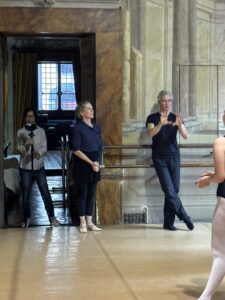
Julie Cronshaw, Peter Brandenhoff at Hamlyn with Mary Lim, photo Elisa Corsini
Cecchetti and Bournonville classes on video and an interview with the Ballet Reign YouTubers
The workshops were attended by Jordan and Eden Lim, two American dancers who run the Ballet Reign YouTube Channel and filmed by Mary Lim. These videos are available on YouTube:
https://youtu.be/Q5nHWXTMuzg?si=RfOJsy7-UE1YEA1u ‘We tried the Cecchetti Ballet Method for 1 week (successfully?)’
And a shorter video of their classes at Highgate Ballet School in London:
https://youtu.be/XdjxnlT_WuU?si=BAJyo4L_ijDwfGsP ‘A non-aesthetic London vlog’.
Recorded at Almadanza by the Ballet Reign team the hour’s interview discussed the historical links (Saint-Petersburg) between Bournonville and Cecchetti and the relevance of their training today. Jordan and Eden Lim, the author, Peter Brandenhoff and the Hamlyn and Almadanza teachers also answered a questionnaire, now available in English on Dansomanie:
Dansomanie :: Voir le sujet – Master-Class Florence et Bologna – Bournonville-Cecchetti
Beyond the visual
Today’s class tends to encourage a frontal view, creating a ‘mechanical’ quality which invites the viewer to measure for error. In contrast to this, Bournonville and Cecchetti enchaînements are ‘3-Dimensional’, or tutto tondo, i.e. equally effective from any angle. The viewer’s focus shifts from scrutinising the ‘physical perfection’ of body shape and line, to a “beyond the visual”, intellectual perception: interaction between dancer, steps and music
Virtuosity serves expression
At Scuola Hamlyn, the students were already familiar with Cecchetti’s Method and used to its scientific approach to technique. Still, they wanted to dance the Bournonville allegros ‘over and over’. Alessandra Alberti noted the value of a workshop that glimpsed ‘”something of the greatness of Bournonville …and the striking affinity to Cecchetti’s work…’” and Elisa Corsini observed: “The barre is stripped down to essentials, while the centre is a treasure-chest… Both methods make virtuosity serve expression…. With these techniques, unless one have an intellectual grasp of the step, exhaustion quickly sets in.”
A moment suspended in time
Pier Paolo Gobbo is a French-trained, former professional dancer. Nevertheless, he also offers Cecchetti syllabus classes to children at Almadanza. He observed that his students were led to “a deeper reflection where one reaches for what lies beyond everyday life.'”
‘The Dance is an Art because it calls for vocation, knowledge and ability.
It is a fine art, because it strives towards an ideal, not only in the plastique but also in the lyrical respect.’
Bournonville’s Choreographic Credo
A brief overview of the Bournonville Style
Bournonville dancers move very differently to those of Petipa, Ashton and Balanchine. The training focuses on developing ballon and to move with effortlessness and élan. There are innumerable linking steps such as the chassé contretemps, which offer musical and rhythmical keys to Bournonville’s choreography.
A radical innovation: Grand Allegro in the 19th century
Pierre Gardel and Auguste Vestris, Bournonville’s teacher at Paris, were most likely the radical innovators who experimented with ballon and ‘grand allegro’ in the early 19th Century, inspired to “fight gravity” by composers such as Beethoven and Schubert.
Big Jumps in Small Spaces
In a 1981 film for the Danish Dance History Archives[6], Dinna Bjørn discusses the Bournonville style, with enchaînements danced in a very small studio, by Karina Elver and Bjarne Hecht of the Royal Theatre. For Bournonville, even a male variation with complex bravura jumps, such as the Wednesday class solo[7] can be fitted into a small space with clever linking steps. It is less of a hindrance than it first appears, as the audience is invited to marvel at the choreographic detail.
While acknowledging that smaller 19th Century stages must have influenced some enchaînements, one should still ask what the choreographer (Bournonville) or teacher (Cecchetti) sought to achieve, and how their aims compare to today.
Comparing Bournonville and Cecchetti’s ‘Days of the Week’
Both masters’ “Schools” are known as The Days of the Week’. Differing somewhat in structure, the similarity of intention is nonetheless clear.
August Bournonville, 1805-1879
Bournonville trained initially with his French father and the Italian Vincenzo Galeotti, ballet master in Copenhagen from 1775-1816.
After perfecting his technique in Paris under the ‘God of the Dance’ Auguste Vestris, Bournonville brought that grace and elegance-and a talent for mime, back to Copenhagen, where he became ballet master and director of the Royal Theatre for most of his life (1830-1877).
In 1849, he composed the ballet Konservatoriet which includes one of Vestris’s classes from the Paris days. These exercises form the ‘Days of the Week’ Friday class: a glimpse of early 19th century French technique – a half-century before Cecchetti was born.
Bournonville’s ideas about life and art aligned with other leading Danish artists in Copenhagen at the time, and his output of more than 50 ballets and divertissements in opera and dramas had idyllic, nationalistic, folkloric, mythic and romantic themes. In his ballets, the leading male rôle was central to the ballet, unlike elsewhere, where the ballerina took precedence. With his influence, Danish dancers gained social equality with other citizens in and outside of the theatre, something that Cecchetti was also passionate about. After Bournonville’s death in 1879, some of his 50 ballets were lost. Nevertheless, the surviving ballets are performed worldwide while his distinctive ‘School’ has since produced many world-famous dancers.
Bournonville’s ‘Days of the Week’
What is now called Bournonville’s Days of the Week is a collection organised after Bournonville’s death by his pupil Hans Beck.
Most Danish specialists have concluded it does not represent a coherent pedagogy, nor is there any “rhyme or reason” to its ordering.
Bournonville’s Etudes Chorégraphiques
In the Etudes Chorégraphiques, we find some theory, such as use of opposition in the arms. Five ‘Positions and Directions’ are listed; these Cecchetti adopted, while adding l’écarté.
The great dancer Erik Bruhn, in his Bournonville and Ballet Technique[8] has weighed into the debate insisting Bournonville was a teacher and brilliant choreographer, who emphasised ‘contradictory characteristics’ in class, the correct use of feet and legs, épaulement, and variety of allegros. As well as taking into account the differences between training men and women, he adapted his combinations to the dancers before him.
In his Appendix entitled ‘Bournonville and Cecchetti’, Bruhn presumes that the two masters must have met at some point as Cecchetti toured throughout Europe:
‘Danced 2 seasons in Copenhagen in the 1870s (although not, apparently at the Royal Theatre) and was also appearing at a summer theatre in 1874, in St. Petersburg when Bournonville visited that city’.
Whether or not they met, Cecchetti certainly learnt to admire Bournonville’s work through the latter’s pupil Christian Johansson, his colleague in the 1890’s at Saint-Petersburg at the Imperial Theatre. Cecchetti went so far as to copy out word for word the Etudes Chorégraphiques and its Credo:
‘I present here, to my dear pupils, some of the fine choreographic studies listed by Mr. Bournonville, reminding them that progress and skill depend on the care with which they are executed. E. Cecchetti’
Cecchetti’s Days of the Week
While Bournonville’s class content is either lifted from his ballets, or would fit them like a glove, Cecchetti was a teacher of grand technique and with this in mind, few of his exercises are suitable for the stage.
Cecchetti’s First Manuscript, 1894
Cecchetti’s first manuscript outlining his theory behind ‘The Days of the Week’ dates from 1894, at Saint-Petersburg. Entitled ‘Manuel des exercices de danse théâtrale à pratiquer chaque jour de la semaine à l’usage de mes élèves’ it was bequeathed to the New York Public Library’s Dance Collection by his student Cia Fornaroli.
In the 1894 manuscript, one finds these telling lines:
‘I have allowed myself to honour my manual with a Foreword by Mr August Bournonville.
In just a few words, Mr Bournonville so ennobles our art that it has given me a real and very great pleasure to transcribe those few words for you.’
Principles and Quality of Movement in Bournonville and Cecchetti’s classes
Aplomb, Epaulement and Vigueur
In Dinna Bjørn’s view, Bournonville’s class must originally have been designed with specific skills in mind, the foremost being Aplomb and ‘Vigueur’. We might describe ‘Vigueur’ as ‘dancing with attack.’
L’Aplomb and Ballon are studied in Cecchetti’s Days of the Week, specifically on Monday in Les Assemblés and on Saturday in Les Grands Fouettés Sautés.
L’Aplomb
The barre serves to prepare the dancer to stand in their centre or in ‘l’aplomb’, also called the plumbline, and for jumping. The centre exercices d’aplomb and pirouettes of both masters fine-tune this aim.
Epaulement
After establishing the plumbline, how to move out from the centre and maintain a balance? Swinging one’s arms naturally in opposition creates balance when walking down the street; the ballet dancer creates a stable form using oppositions in the arms, shoulders and head. These are held in the torso. In Cecchetti épaulement is specifically explored in the Tuesday class.
Furthermore, épaulement increases the opposition, expanding its dynamic potential or enabling its release into the next shape.
Bournonville controls the dynamic unleashed in the ballon combinations through épaulement.
Ballon, or bouncing
These steps belong to the grand allegro category: the run-up step lends its impetus to the highlight jump. Once mastered, the bounce-momentum becomes self- generating. Cecchetti’s Saturday class explores this avenue, which gathers all the principles in the preceding Days of the Week.
In contrast to Cecchetti’s focus on ballon on the Saturday, every Bournonville class includes several such exercises.
‘The height of artistic skill lies in concealing all mechanical effort and strain beneath harmonious calm.’
Bournonville’s Choreographic Credo
Contrasting the teaching methods of Cecchetti and Bournonville
Bournonville: Teaching through Choreography
In the Etudes Chorégraphiques, there is little theory; but one finds lists: of body and arm positions, attitudes, arabesques pirouettes, steps with variants. In other words, Knud Arne Jürgensen has noted, it is more of a guide rather than a manual. For his part, Erik Bruhn writes in ‘Bournonville and Ballet Technique’, that the steps are listed in the order that they would be done in class – by competent dancers. There are eight long Etudes d’Aplomb (adages) and pirouettes: ‘in every possible position known today’ along with 121 different enchaînements for Etudes de Ballon and Temps battus.
Cecchetti: An analytical approach
Cecchetti’s Days of the Week, was developed from both the French and Italian schools, incorporating steps from the Italian grotesque tradition along with virtuosic pointe work. They perfect each Day’s step-family movement quality. No step can be forgotten, as the same cycle returns the following week.
Aisance, and Virtuosity for its own sake
In contrast to the aisance of the Bournonville style where all effort is disguised, Cecchetti’s class virtuosity is celebrated ‘for its own sake’. He too insisted that there be no obvious exertion but his approach to bravura steps and multiple pirouettes is different: they appear in stand-alone combinations.
‘Through the aid of music, the Dance can rise to the heights of poetry….’
Bournonville’s Choreographic Credo
Musicality
Musicians need not fight gravity. In music swift thought is very nearly matched by the instrumentalist. Not so in dancing. Although we hear, we can neither move that fast nor realise in physical form all the musical concepts.
The dancer may be considered the ‘extra line’ in the music. Bournonville chose composers at the Royal Theatre whose music would not dominate the choreography but enhance the dancer’s ‘extra line’, just as a pianist accompanies a solo instrument or voice. And so, the dancing becomes the dominant and ‘aspirational’ element of the performance.
In the ballet studio, until the 20th century, accompaniment to dancing classes was provided by a violin. In Bournonville’s class scene in Konservatoriet the ballet master plays the violon pochette and Legat’s caricature of Cecchetti as a grasshopper holds one. In his later years at the Ballets Russes, Cecchetti had piano accompanists.
Melodic Line, Rhythmic pulse
Both Mr. Brandenhoff and the author agree that teaching class requires music with harmony and rhythm, and that when one has learned a step with the ‘right’ music, (a bone of contention amongst teachers!) the better to understand its dynamic quality. Peter Brandenhoff thought that the way in which Bournonville uses musicality was a significant challenge for the students.
The author’s teacher for two decades, Roger Tully, commented on the musicality of Bournonville, noting that he follows the melodic line, which makes sense for a choreographer. In contrast, Cecchetti’s musicality appears to follow the rhythmic beat. This might be an experiment worth trying: a Cecchetti Method class accompanied with piano accompaniment then repeated with violin accompaniment.
‘Every dancer ought to regard his laborious art as a link in the chain of beauty, a useful ornament to the stage, and this in turn, as an important element in the spiritual development of nations.’
Bournonville’s Choreographic Credo
Conclusion
The author realises that the simple decision made at Lille to alternate Bournonville and Cecchetti’s exercises within the same class was the defining instant of the experiment.
Peter Brandenhoff noted that the collaboration in the studio brought a directness and depth to the classwork that a ‘faculty’ discussion alone could not do. He shared a long-held theory:
“The language of dance is universal, but it has gotten to a point where the “dialects” and idiosyncrasies are becoming something I think we as teachers must keep in mind. Much can be lost in translation, particularly in details of a step and its how-to that may be understood differently from one place to another.”
‘Après nous le déluge!’ [9]
Bournonville and Cecchetti held similar points of view about their art. Both complained about its ‘vanity and decadence’ and declaimed its rebirth in Russia.
“How did we get to where we are today in the world of the classical dance?”
Over the course of the 20th century ballet technique changed to suit ideologies rather than ideas and the emphasis shifted from telling stories and using steps and mime to communicate ideas to the display of the body itself. Now in the 21st century, there is an obsession with the ‘body-beautiful’ and hints of transhumanism. Cecchetti was ahead of his time when he decried the ballets of his final years as “bizarre and tormented by futurism”. Not much has changed.
Let us be positive! Cecchetti and Bournonville saw ballet as a Movement in the Mind. Cecchetti wrote that its beauty would ‘transform but not ever perish’.
The workshops proved the value of this experiment. Cecchetti’s scientific approach to technique worked in accord with Bournonville’s enchaînements and alternating the masters’ exercises side-by-side shone a light on both, encouraging the participants to think and work differently from usual.

Cecchetti meets Bournonville Almadanza, October 2025
Harmony and Happy Endings
Erik Aschengreen, Danish historian and dance critic, wrote:
‘Bournonville maintained that art should be positive; its purpose was to elevate us and make us into harmonious human beings. Harmony is the keyword in his ballets, and this harmony is to be found not only in the stories and the happy endings of his ballets, but also in this style of beautiful proportions and delicate musical timing.’
Maestro Cecchetti advised his London pupils:
“Visit the famous art galleries of the world…Seek to discover why these works afford you pleasure. Thus you will learn what is meant by grace and beauty. Endeavour to apply these principles to your own art.”
Addendum:
Original class list for Hamlyn, concept of aplomb and épaulement. Nb. Bournonville: B. Cecchetti: C.
Short barre
Centre:
- Adage: Monday 1
- Grande Préparation pour pirouettes en dedans à la seconde/attitude
- Equilibrium/Relevé: Monday 4
- Grande Préparation pour pirouettes en dehors 1 to 4 turns
- Tuesday pirouette Giselle
- B Sautés: Tuesday 8
- C: Temps levé, chassé, coupé assemblé etc.
- Monday 12 pas couru, temps de flêche
- Tuesday pas de bourrée, dégagé, fouetté etc.
- Sissonne Tuesday 11
- Fouetté sauté à six temps 1
- Tuesday 19 The Crossing step
- First & Second set of Ports de Bras
- Révérence
Essay by Julie Cronshaw, London, April 2026
[1] https://youtu.be/ZGT4g7FHSvA?si=LQote3IxLwTr6QfX and accompanying essayhttp://www.thececchetticonnection.com/cecchetti-days-of-the-week/
[2] http://www.thececchetticonnection.com/a-glimpse-into-the-spanish-world-cecchetti-bournonville-and-the-escuela-bolera/
[3] The Bournonville School Centre can be viewed in its entirety on YouTube: https://youtu.be/lGmh14Qn6EQ?si=vdxWe7LQC7DTcWKw, Monday Class No.1 at 0:51
[4]Ibid. https://www.balletsecretcode.com/videos-collection-list-of-contents/
[5] A list of the workshop exercises appears at the end of this essay
[6] https://youtu.be/UPqb2r-ZHYw?si=gkbYEUfOR_mIKOBl
[7] Ibid: https://youtu.be/UPqb2r-ZHYw?si=gkbYEUfOR_mIKOBl at 24:24
[8] Erik Bruhn and Lilian Moore: Bournonville and Ballet Technique, Dance Books, 2005
[9] Bournonville, Second Letter, trans. by Knud Arne Jürgensen


